07 November
Halloween stories
On the Friday before and the Monday after Halloween, I visited six more schools to read out spooky stories. I enjoyed myself. At one school I read out at assembly, to about two hundred children from nursery school age to P7. At another school everyone gathered to listen - about thirty in all! At a special school all the children listened very intently; and at one primary school I was cross-quizzed for what seemed like hours on exactly what the Grumpy Browns had been up to when they tied string to their front door. I even had to give an autograph! So thanks are due to: Troon Primary School, St Patrick’s Primary School, Muirhead Primary School Fisherton Primary School, Invergarven Special School and Minishant Primary School. I ended up reading five different stories: Nearly Nine, The Grumpy Browns, Wheelybins, Christmas Wishes and Wings. I think Wheelybins and The Grumpy Browns went down best. Useful information, as I shall probably be visiting another round of about ten schools in the new year!
22 October
Supernatural Tales
The good folk at Glasgow SF Writer’s Circle suggested that Supernatural Tales would be a good place to submit a traditional ghost story - so that’s what I did. A few weeks ago I sent off The Ticket Collector for consideration. And I’m glad to be able to report that it has been accepted, and should appear in the Spring 2011 edition of the magazine. [You can now, of course, read this story on this updated site by going to the section on stories.]
22 October
GSFWC and Niffen
So, last night I ventured up to the Glasgow SF Writers Circle, new story in hand. I had to ask everyone to shout at me as my hearing isn’t so clever these days, but when they did get round to shouting at me, I was pleasantly surprised at what they shouted. They liked it. Oh, there were one or two niggles, most of which I will sort out, and a handful of which I thought unjustified. There was quite a bit of discussion over the ending, because some of them thought it clearly showed an ‘end of the world’ scenario, whereas others weren’t so sure.That pleased me immensely, as that was exactly the ending I had been aiming for - ie nobody knew whether the alien ship heading towards Earth was planning to fry everyone in sight, or open up its hatches to a brave new world. One problem which caught their attention was the fact that the latter stages of the Niffen Enigma were solvable by mathematics in base 10, perhaps not reasonable given the utter alieness (alieness? is that a word?) of the Niffen Fragment itself. This was a mathematical problem which I already knew about, but I couldn’t think of a way round it. So thanks to Hal Duncan, who was at the meeting, and who came up with a non-mathematical solution, which I shall incorporate in due course. After a redraft later this year, I’ll try submitting Niffen #2 to a magazine or two. Fingers crossed. Watch this space.
22 October
On audiences
When we went to see UP the other day, it was refreshingly different to sit in a cinema which wasn’t empty. This isn’t an idle remark. Not long ago Ivy dragged me out to Ayr Odeon to watch (500) Days of Summer (typical light romantic comedy - not great but not awful - probably not worth going unless you are really hard up for something to do, but might be worth renting the dvd in due course if that’s your kind of film) Anyway, the point of this story is that Ivy and I were the only members of the audience. Literally. We were the only two viewers in the entire auditorium. Somehow small audiences detract from the pleasure of watching a film… and you can’t get much smaller than two. I remember watching One Flew Over the Cuckoo’s Nest years ago in a fleapit cinema in Cardiff and the place was absolutely packed. Even the steps had people sitting on them. I remember our collective amazement and shock when Chief Bromden suddenly says something, when up until then everyone had assumed he was mute. I remember going to early showings of Star Wars films, when you either had to book early or queue round the block to get a ticket (hence ‘blockbuster’ by the way). More recently, I remember all three Lord of the Rings films being total sell-outs. Watching those films along with so many others added enormously to the experience. Another time I watched Carrie - the entire audience on the edge of its collective seat. Carrie makes one knife fly up to stick in her mother’s hand, then another, then another, and some wag in the packed audience called ‘one hundred and eighty!’, and the tension lessened as the whole place erupted in laughter, but not so much that we failed to leap into the air with shock at the final closing, classic seconds of the movie. Would it have been the same with only a handful of people watching? Or only two? I doubt it. Somehow a cinema audience feeds off itself, and that aspect of the ‘cinematic experience’ is conspicuously lacking when hardly anyone turns up to watch a film.
22 October
Awkward questions
Michael visited us at the weekend, and Dylan immediately wanted to play hide and seek. Michael was tired and suggested that perhaps Mummy or Daddy would play. ‘Hmm,’ said Dylan. ‘That would probably be Daddy, then. He’s always liked me. Later that day he climbed up onto my lap, his little face crumpled and tearful. ‘Daddy,’ he said, ‘why do we all die?’ I informed him that it was just one of those things, but everyone did. ‘But I don’t want to die!’ he wailed. I said not to worry, it wouldn’t be for ages and ages yet. At this, he grew thoughtful. ‘When’s Nanna going?’ he asked. I said I really didn’t know but that I didn’t think Nanna had any immediate plans for going. ‘But you know everything!’ said Dylan. ‘No, I don’t,’ I said. ‘Yes, you do,’ he said, nodding at me encouragingly. ‘I don’t!’ ‘You do!’ I thought at least the discussion was getting back to a manageable four-year-old level, but then he abruptly asked: ‘Do we come back?’ ‘I don’t know,’ I said. ‘Nobody knows.’ ‘Why not?’ ‘Um. I don’t know.’ ‘But Daddy, you know everything.’ At that point Handy Manny came on the tv and I was never so glad to see a children’s cartoon programme. I just hoped none of the tools had a dreadful accident and had to be replaced. At the time, I breathed a sigh of relief, but I suspect my grilling on philosophical matters has not finished.
11 October
Chinese lessons
I am delighted to be able to report that Ivy has secured a Mandarin adult learning class. It takes place in Troon, in Marr College, every Tuesday from 7pm to 9pm. There are spaces available on the class, so if you are interested in learning Chinese ‘ either as part of a class, or privately. Ivy has worked as a freelance interpreter for some time now, affiliated to the Glasgow firm called Global Connections . So if there is anyone in the Ayrshire area out there who needs some help with Mandarin or Cantonese you know who to contact!
26 September
New story
At long last I have completed a new short story. It’s called The Niffen Fragment, and you can download it from within the stories section of this site. Comments welcome. On 20th October the Glasgow SF Writer’s Circle will collectively critique it. I’m not sure whether I’m looking forward to that or not, but I have been commenting on other members’ stories up until now, so I suppose it’s only fair that they get the chance to comment on one of mine! Watch this space for how it turns out.
08 September
poofreading curse
I’ve started work on a proofreading course, run by the Publishing Training Centre. I’m enjoying it, despite the fact that at the end of each unit I have to send off an assignment to be marked, and I had thought my days of taking exams or tests were long over. The course comes in five units (I only have the first two to be getting on with) and apparently it can take about a year to complete. I shall be surprised if it takes me that long, but watch this space. My plan is to also take the course for copy-editing, and then to join the Society for Editors and Proofreaders (SfEP) as an associate, and look for some freelance business. All this in the future, and a big unknown. How did this come about? Well, I have been wondering for some time what I might do if I retired early and wanted some part-time work to boost pension funds. At the Glasgow SF Writer’s Circle I met Lawrence who is already a member of SfEP and who works full time as a copy-editor. This reminded me that I used to do some editing in a previous job, and that I had enjoyed it. So after some surfing around and some advice from Lawrence, I joined up with the Publishing Training Centre and here I am working my way through the curse.
08 September
Three more schools
On Friday 4th September I went to three different schools to read out stories from As They Grow Older. Everything went very well. So a big thank you to: St Ninian’s Primary school. The P1 class all dressed up as various characters and their outfits were fantastic. I read them Nearly Nine and mentally apologised to any parents if the story kept any of the children awake that night. Prestwick Academy. A class and a half crammed into one room. I put my website up onscreen, gave forth a few tips on what to do and not to do when writing a spooky story, and then read out Here Be Giants. Most of the children seemed to enjoy it - but I have my doubts about two boys at the back who spent most of the time whispering to each other! Braehead Primary school. Two P3/4 classes filed into one big room. I showed off my website again, and gave a shortened version of the writing tips, before reading out Wheelybins. This seemed to go down well, and the children had lots of questions at the end. One boy informed me that he was going to write even more stories than I have. Well, if I have inspired just one child to go on to be a writer, my day was well spent.
09 August
Most Of Us
We come in
Free of sin.
We go out
Full of doubt.
In between
We mark our slate
And try, too late,
To wipe it clean.
sc
circa 2004
26 July
More about books
A number of people have asked which books didn’t quite make it into my top twelve (see earlier post). Well, all I can say is, be careful what you ask for! Her you are, in no particular order:
Foundation Series by Isaac Asimov
Weaveworld by Clive Barker
Tiger! Tiger! by Alfred Bester
Farenheit 451 by Ray Bradbury
Lone Star Ranger by Zane Grey
Catch 22 by Joseph Heller
The Mind Thing by Frederic Brown
Papillon by Henri Charriere
The ABC Murders by Agatha Christie
Ministers of Vengeance by Robert Conot
Dhalgren by Samuel R Delaney
An experiment with Time by J.W.Dunne
American Gods by Neil Gaiman
Twilight for the Gods by Ernest Gann
I, Claudis by Robert Graves
The Darwath Trilogy by Barbara Hambly
The Crimson Petal and the White by Michael Faber
A Brief History of Time by Stephen Hawking
Pilgrimage by Zenna Henderson
Dune by Frank Herbert
The Farseer Trilogy by Robin Hobb
The World according to Garp by John Irving
It by Stephen King
The Stand by Stephen King
Wasp by Eric Russell
A Kiss before Dying by Ira Levin
Narnia series by CS Lewis
Out of the Silent Planet by CS Lewis
Call of the Wild by Jack London
Fear is the Key by Alistair Maclean
Melmoth the Wanderer by Charles Maturin
Saga of the Exiles by Julian May
Perdito Street Station by China Meiville
There came both Mist and Snow by Michael Innes
Five Children and It by Edith Nesbit
The Phoenix and the Carpet by Edith Nesbit
Lucifer’s Hammer by Larry Niven and Jerry Pournelle
Summer of 42 by Herman Raucher
Fifth Form at St Dominics by Talbot Baines Reed
The King Must Die by Mary Renault
When the Lion Feeds by Wilbur Smith
Grapes of Wrath by John Steinbeck
Anathem by Neal Stephenson
Merlin Trilogy by Mary Stewart
Wolfen by Whitley Streiber
The Virgin Soldiers by Leslie Thomas
The Hobbit by J.R.R.Tolkien
Herries Chronicles by Hugh Walpole
Memory, Sorrow and Thorn by Tad Williams
Neverness by David Zindell
Jonathon Strange and Mr Norrell by S Clark
OK, so now that you know – how many of these books have you read, and what do you think of the choices?
18 July
Not Many People Know That
We were having tea in a room growing darker by the second as black clouds massed over Ayr. It was hot and humid, not Scottish weather at all. Suddenly a single clap of thunder sounded, just above our house it seemed, and its echoes dinned in our ears. When it was quiet again, Dylan looked up and said in a passable Cockey accent, ‘You were only supposed to blow the bloody doors off!’ (And if you don’t know the origin of this quote, shame on you - your cinematic education is sorely lacking.)
07 July
Wimbledon 2009
So Federer has done it again, battling past Roddick in a mammoth five-setter. It might have been the longest men’s final, but was it the longest men’s match? I seem to remember watching a certain Charlie Pasarell play Pancho Gonzales many years ago, which is usually cited as the longest match - years before the advent of tie-breaks, of course - hang on a minute while I go googling. Ah yes, here we are. 1969 and well over five hours on court. Do you know, I remember watching the match all right, but I had forgotten who actually won it. (If you want to find out who did, go here. That’s not likely to happen with the Federer-Roddick result, I suppose. So is Federer the best ever? What do you think? I don’t think there’s any doubt that Navratilova was the best ever woman player: playing at somewhere near her best, I’m sure she would wipe out either Williams sister, especially on grass. But Federer? Everyone says he’s the greatest, but I have a sneaking feeling that if we were able to give a young Laver the benefits of modern technology and training, then we might all be in for a surprise.
04 July
Going Backwards
A few weeks ago, Ivy, Dylan and I flew down to London for a long weekend, to stay with my old friends David and Lydia. It was an interesting experience for a number of reasons. David had managed to break his arm by tumbling off a ladder, so he was unable to pick us up as planned and we had to find our own way to sunny Cheam. Not to be outdone, I had just hurt my back somehow and sustained what the hospital doctor described as ‘mechanical damage’, and was hobbling round in constant pain. David and Lydia have no children and freely admitted that they didn’t know what to do with them. David spent the entire weekend worrying about his cat, which had taken to vanishing as soon as Dylan appeared. I tried to tell David that this was normal. ‘Cats and children don’t mix,’ I told him, but it didn’t work. David spent hours peering around the garden, worrying. ‘I knew there was a reason we didn’t have children,’ he muttered. We took Dylan to the Natural History Museum. He loved the gigantic dinosaur skeleton in the entrance, and gawped at the ‘real life’ tyrannosaurus rex. But he became disinterested in bones and stuffed animals. He wanted to go outside and play on the swings and slide we saw on our way in. ‘We didn’t come all the way to London for you to play on swings and slides,’ I told him. But he dragged us back to the entrance (he has a remarkably well developed sense of direction) and David muttered that he knew there was a reason why he hadn’t bothered to have children. In the end we marched up the road to the Science Museum, which with the benefit of hindsight is what we should have done in the first place. Dylan absolutely loved the machines, and I believe he took me to see every single exhibit while Ivy, David and Lydia (curse them all) waited in a coffee shop. But it is for none of these reasons that we will remember the trip. On the way back, we were sitting on the plane at Stansted. The captain came on the air and said in the usual captain monotone: ‘blah blah we will be flying at thirty thousand feet, at approximately five hundred miles an hour, blah touch down in Prestwick slightly ahead of time, weather in Scotland not as warm as in London, blah blah blah sit back and enjoy the trip. Thank you.’ At which point one of the airport vehicles buffered up to the plane and pushed it back out towards the runway. Dylan grabbed at the end of his seatbelt and, pretending that it was a microphone, announced ‘the plane’s going backwards. Over?’ - much to the amusement of the dozen or so passengers within earshot.
04 July
My top twelve favourite books
I was going to write a post on my top ten favourite books, but I couldn’t hold it down to ten. Never mind, here’s a round dozen instead. A point of definition before I start: ‘top twelve books’ could mean the twelve books currently standing in my favourites list, or it could mean the twelve books which had most impact on me when I first read them. Tastes change. A book which had tremendous impact on me twenty years ago might seem terribly-written or trivial to me if I picked it up again now. In fact, here are two (admittedly extreme) examples: my mother said that when she was young, she thoroughly enjoyed reading stories by Dornford Yates, but she tried one again recently and informed me that it was ‘awful, just awful’; and not long ago I picked up a Biggles book (I admit it, I was brought up on Biggles, Gimlet, Bunter and Just William) ‘ and it too was awful. The worst thing about it was that it seemed very racist ‘ not something I noticed at the tender age of nine or ten, but it sticks out like a sore thumb now.So, in no particular order, these are the twelve books which probably had most effect on me when I read them:
Lord of the Rings (1954) by J.R.R.Tolkien.
Everyone knows about LOTR now, of course, but I first read it as a boy, only ten years or so after it had been published. I remember lying on the beach at Shoreham-by-Sea during the summer holidays, devouring page after page, enthralled by the dark happenings in deep Mordor and across Middle Earth. When some fool of a family member sprinkled sand or icy water down my back, I would jerk into the real world and be absolutely astonished to find the sun shining. I also remember seeing a documentary on LOTR years later. The programme showed two academics discussing how the book was clearly an allegorical account of the differences in East-West philosophy and political thought. Then it cut to JRR himself, who said, ‘No, it’s just a story.’ I still think that was hilarious.
Shogun (1975) by James Clavell
I loved Shogun for two reasons. First, I thought the differences between the East and West civilizations were brilliantly depicted. The way the crew of the ship thought and acted seemed normal enough at the start of the book (a bit brutal, but what would you expect of sailors in the fifteenth century?), but by about half way through, when ‘Anji-san’ was coming under the influence of the Japanese, they seemed at best uncivilised, and by the end of the book they seemed positively sub-human. Second, I was captivated by the twists and turns of the plot. It was always pretty clear what the various Westerners wanted; but the motives of the Japanese were always convoluted. I was fascinated as almost every page revealed wheels within wheels as the characters set about manipulating each other - even to the very end, with the firing of the ship.
The Ninja (1980) by Eric van Lustbader
Van Lustbader was the creator of the brilliant Sunset Warrior series (which pre-dates The Ninja) and of course now has a string of best-sellers behind him. But it’s easy to forget that The Ninja somehow straddles the pure zen-like action from the Sunset Warrior, to the more modern thrust and parry of martial arts in today’s world. What I remember most about The Ninja is the amazing descriptions of action. The book took physical movement and described it in dreamlike detail, but twisted timeframes so that action and counter-action took place in a fraction of a second. I was astonished by the visions conjured up in my own mind. It was almost like The Matrix in book form, long before The Matrix was as much as a gleam in a producer’s eye.
Monte Walsh (1963) by Jack Schaeffer
Jack Schaeffer is perhaps best remembered for writing Shane (itself made famous by the film and Alan Ladd’s portrayal of the lead role). It is a good book which for some curious reason featured as a ‘set book’ in my English literature classes at school. But in my opinion, Monte Walsh is much better. It tells the life story of a cowboy, from the time he ran away from home to his last days obstinately riding horses even though automobiles were making their presence felt. It is funny, sad, uplifting, grim in places: ultimately you have to be one tough hombre if you don’t feel tears springing to your eyes when you read the last words: MONTE WALSH 1856 – 1913 A Good Man with a Horse. Monte Walsh was also made into a film, which has attained a cult status over the years. I recommend it if it ever gets a repeat showing on television.
Earth Abides (1953) by George Stewart
End-of-the-world stories are two a penny nowadays, but that wasn’t the case when Earth Abides was published (the first of the well-known Science Fiction Book Club) in 1953. Certainly it was the first such story that I read (I must have been about thirteen or fourteen) and it had a huge impact on me. At the start of the book, its lead character Ish is bitten by a snake while hunting in the mountains. Unknown to him, this is the best thing that could have happened, because the snake venom is fighting a virus which is even then decimating earth’s population worldwide. I remember sharing Ish’s sense of bewilderment when he returned from the mountains to find that almost everyone he had ever known had died; I shared his commitment as he fought to draw together a decent community; and I felt enormously sad when I read the final words: hen, though his sight was now very dim, he looked again at the young men. ‘They will commit me to the earth,’ he thought. ‘Yet I also commit them to the earth. There is nothing else by which men live. Men go and come, but earth abides.’
The Lensman Series (1934-48) by E.E.’Doc’ Smith
‘Virgil Samms, now and forever!’ Space battles, intertialess combat, buckets of blood (much of it alien), super-intelligent civilisations battling over the future of the universe, and the almost magical, mind-enhancing Lens itself - you name it, the Lensman Series has got it. Nowadays the non-development of character, superficial (if sweeping) plot and general reliance on scores of ‘good vs bad’ battles played out through the centuries would seem over-simplistic. Today’s reader perhaps asks for more; more detail, more introspection, more and better reasons for willingly suspending disbelief. But at the time it was written it was a remarkable achievement, hailed by many critics nowadays as the birth of modern science fiction. I was blown away by the Lensman Series when I read it sometime in the 1960s, and still aspire to emulate Nadrek, the super-patient alien who spins the faintest of traps across time and space, and always gets his… no, not ‘man’… his prey. And as testament to the longevity of Smith’s creation, my daughter - nineteen going on twenty as I write this - still lists the Lensman Series as her favourite book.
The Shining (1977) by Stephen King
The Shining was one of Stephen King’s first books, and I read it long before a manic Jack Nicholson took up the axe in the famous scenes from the film. In fact, I can remember reading most of the book on daily train trips. I must have been commuting from somewhere to somewhere, packed cheek by jowl with hundreds of other commuters… but I had evaded the crush and was somehow transported to the Overlook Hotel, completely immersed in the terrible events unfolding as Jack Torrance descended into madness. Rather like the time when I read Lord of the Rings, I was always astonished when the train shuddered to a halt at the end of the line, and I was reluctantly jolted back to the real world. I think Stephen King is vastly underrated as a writer. His books offer much more than gory or terrifying horror. The characters are well developed and the world they inhabit is brilliantly described, so much so that one day history students will be able to use his books to gain a picture of how the world must once have been. Finally, I had to think hard before deciding whether to put The Stand or The Shining here in my top ten list. It was a hard decision and I am still not sure whether I have got it right.
Aztec (1980) by Gary Jennings
Aztec is a vast, sprawling novel describing the Spanish conquest of the Aztecs, as seen through the eyes of an aged Aztec who somehow avoided the slaughter. Full of dry humour and wonderful historical detail, the story doesn’t mince words when it comes to the brutality of the Aztec civilisation (or for that matter, the brutality of the Spanish). It is a big book, even by today’s standards, but I remember carrying it around with me for days, feeling more in tune with the ancient Aztec civilisation than I did with twentieth century commuter-land. Lots of detail stick in my mind, but one horrible incident was the description of sacrificing children by coating them with gold; and I also remember how the old Aztec relating the tale would deliberately tell stories of sexual licentiousness, knowing that it would (secretly) stimulate and (publicly) horrify the friars recording his every word.
Lolita (1955) by Vladamir Nabakov
No doubt when I started to read Lolita many years ago, I was half hoping to read semi-pornographic descriptions such as those in Violette Leduc’s Ravages, or in the more recent and apparently never-ending series of Emannuelle novels. If so, I was sorely disappointed. There is nothing whatever pornographic or even overtly sexual in Lolita, but on the other hand it is a wonderfully written story of the dreadful events which took place in the days and months after Humbert Humbert took up residence in the house of Charlotte Haze, and took a fancy to her under-age but precocious daughter. It is powerfully written without being pretentious; images just fly off the page and lodge in your memory forever. Long after reading Lolita I saw an article in a magazine reporting an interview with Vladamir Nabakov. The reporter asked something like, ‘Do you have any regrets? What would you change if you could?’ and Nabakov replied that he really wished that he could write as well in English as he did in Russian. That made me think, given that he has written one of the most famous books in the English language!
Three Men in a Boat (1889) by Jerome K Jerome
Generally speaking, humorous writing doesn’t last well. Pick up something that was described as hilariously funny just ten or twenty years ago, and the chances are that you will find the style of humour completely out of date. We have all seen the same thing happen to TV comedy programmes: what we find funny now would have seemed over the top twenty years ago; and what we found funny then seems hopelessly twee now. So isn’t it amazing that Three Men in a Boat is still as fresh and funny today as it was when it was written more than a century ago? I defy anyone to read it and not laugh at the antics of Uncle Podger trying to fix up a picture; at the author reading a medical dictionary and being most put out that he had the symptoms of everything but housemaid’s knee; at the description of how the British public behaves when forced into close proximity in a railway carriage; and many others. I loved it. I think it is a forgotten masterpiece that should be made mandatory reading in schools.
The Lost World of the Kalahari (1956) by Laurens van der Post
I don’t often read non-fiction, and when I do it is usually popular science like A Brief History of Time, or The Life of Pie. But when I was small my great-aunt gave me a pile of books and one of them turned out to be The Lost World of the Kalahari. I had never heard of Laurens van der Post, and indeed it was only comparatively recently that I found out that he was such a celebrated author and philosopher. But I was captivated by his descriptions of the bushmen and the Kalahari. The smooth writing; the subject matter; the photographs; perhaps my own impressionable age - it all came together and gave me an ecstatic jolt that I can still remember even after more years than I actually want to remember. I don’t think I have ever had such enjoyment reading a non-fiction account and I don’t expect to again (although a friend tells me I must read Xanadu by William Dalyrimple: well, we shall see).
HMS Ulysses (1955) by Alistair Maclean
I don’t usually read war novels, not even fictionalised accounts of real events. I can’t now recall why I read HMS Ulysses. It’s possible my grandfather gave it to me, or it was in the pile of books from my great-aunt. It’s even possible that I thought it was pure fiction when I picked it up. Well, whatever the reasons behind it, I’m glad I did. HMS Ulysses is absolutely stunning. The realism is so gritty that at times it is positively horrific, and yet the heroism of the ship’s crew constantly shines through. The story is absolutely chock full of terrific scenes. For some reason the part that sticks in my mind is when the captain (whose mind is beginning to go through shock and horror) comes out on deck, barefoot, in sub-zero temperatures. Maclean went on to write lots of good adventure thrillers - almost everyone has heard of Ice Station Zebra and the Guns of Navarone, for instance. My personal favourite is Fear is the Key, which has one of the best opening scenes of any book I’ve ever read. But even Fear is the Key can’t hold a candle to HMS Ulysses.
So there you have it. What do you think of these choices? How many of these books would be in your top ten or top twelve favourite books?
28 June
Forehill Primary school
On 5th June 2009 I screwed up my courage and went to a local primary school to promote As They Grow Older. The teachers there arranged for me to speak to the two P7 classes (separately, so I had to give my talk twice). By the end of the afternoon, after I had spoken about what was in the book, explained why I wrote the stories, given some tips about writing spooky stories, and actually read out a story - all of it twice - I was as hoarse as a dehydrated frog, but was pretty pleased about how everything panned out. The children were attentive, polite, and asked a lot of perceptive questions. They all said they enjoyed Wheelybins, even though I admitted it was probably more suited to children in P5 or thereabouts. (The trouble was that later stories are longer, and I wouldn’t have had the time to read one of them out, even if my voice had held out for long enough.) Yes, all in all it went pretty well, but what most impressed me was the equipment available in both classrooms. Computers were dotted all about the room, and both teachers had laptops hooked up to some fancy projector thing which threw images onto a whiteboard. This was especially useful as I was able to connect to the internet, log on to my own site, and browse through the thumbnailed illustrations for As They Grow Older. Much better to be able to show them, than stand at the front waving the book in the air, explaining that (really, I know you can’t see them at the back but there are illustrations inside. It was quite apparent that all the children had access to the internet at home, so I did my best to drill home the name of my website (it isn’t so hard to remember, is it?) and hopefully some of them will look it up and ask Mum or Dad to buy a copy of As They Grow Older. We shall see.
01 July
Memories of an unbroken pot
I took Ivy and Dylan to a Chinese restaurant and supermarket in Glasgow last weekend, and as usual got completely lost. I can find my way round 99.9% of the UK reasonably well, but don’t ask me to find my way around Glasgow. Just don’t. By the time I finally found the Chinese place I was fraught, and failed to notice a small traffic island strategically placed right in the middle of the entrance. When I drove over it, the noise as we first lurched up, and then banged back down was indescribable. ‘Is the car broken?’ shrilled Dylan. Fortunately it didn’t seem to be, and as I searched for a parking place I was reminded of an incident many years ago. I had gone to the Ayr Flower Show to buy a large garden pot for my first wife, who loved growing flowers. As I heaved the enormous pot into the boot of the car, I thought, ‘Must drive smoothly. Must drive smoothly.’ The last thing I wanted was to present Mary with a three-dimensional clay pot jigsaw puzzle. So. The first thing that happened was that I turned left out of the Flower Show instead of right. I have no idea why. ‘Got to turn round,’ I thought. The next thing that happened was that I passed a hotel on a corner which boasted a big car park, and I decided to drive in there to turn round. So ‘ smoothly‘ I turned into the car park. Once in, I noticed that the car park extended round behind the hotel and there was an exit on the corner I had already passed. So no need for awkward three-point-turn manoeuvres. I could just drive round to the other exit ‘smoothly’ and head off for home. Unfortunately I had failed to notice that there wasn’t just one car park, but two. Further, they weren’t actually connected except by a flight of steps clearly designed for pedestrians. Oblivious, I headed for the distant exit, and suddenly found myself driving down a flight of steps. This, if you can believe it, in a large 1.8 Austin Montego. As I bump-bump-bumped my way down, I glanced out of my side window and saw a number of hotel guests having late lunch or something, forks poised half way to gaping mouths as they stared at me in astonishment. I gave them a jolly wave, as if this was something I did every day. After what seemed like an interminable number of bumps, I reached the level of the second car park and proceeded home. The car was undamaged. The pot, unbelievably, was in one piece. By the time I found a parking space in Glasgow, my good humour was quite restored.
02 July
Glasgow SF Writer’s Circle
A few weeks ago I started reading Vellum by Hal Duncan, and I noticed at the start a reference to the fact that the author is member of the Glasgow SF Writer’s Circle. After googling around I found their website, and sent an email asking if I could attend. The answer was yes, so yesterday evening I hopped on the train and ventured up to Glasgow, fully expecting to get lost as I always do in Glasgow, but in the end finding the place with no trouble. The meeting focused on a short story called The Forgotten Fortress. Here is not the right forum to discuss the story, but the way in which the meeting was structured was good (and tough). About twelve members were present. Each person had their (uninterrupted) say on what they thought was good and bad about the story - including me, although as I was about tenth in line, most of my comments had already been made by somebody else. Then the author had a few minutes to ‘explain himself’ as the chairman put it. The twelve reviewers had an awful lot to say, and although some of it was grandstanding, I estimate that 80% or more was directly useful to the author. A lot of the comments were very much to the point, but the writer of the short story took it all on the chin and thanked everybody in their turn. I thought this was a good set-up, a little reminiscent of a real-life version of Zoetrope.com, which is a brilliant (and free) writer’s resource. I will probably go again, assuming I am welcome, and so will probably refer again to the Writer’s Circle later in these pages.
30 June
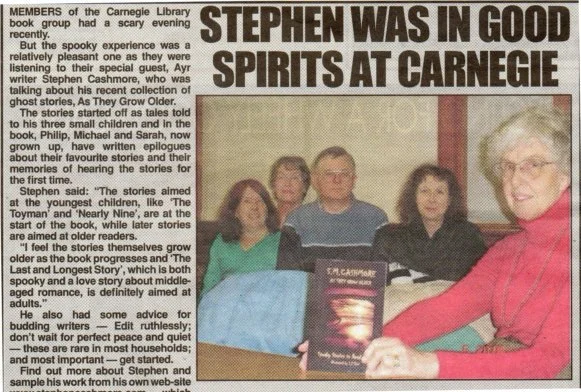
Carnegie Library reading group
On 5th June 2009 I took up an invitation to give a talk on my book As They Grow Older to the Carnegie Library reading group. As They Grow Older is a compilation of spooky stories that I wrote for my own children as they grew up , and there’s a good deal more about the stories, and the book, elsewhere on this website.
I enjoyed giving the talk (and even sold a few copies of the book!).
And a few days afterwards found myself in the local press.
29 June
Parallel universes and quantum physics
As usual, number one son Philip returned from university with a large number of new novels which he really shouldn’t have bought given that his student loan already represents a sizeable proportion of Scotland’s GDP. As usual I read my way through them, not expecting to find anything that would make my top twenty favourite books of all time, never mind my top ten. But for once I was wrong. The first book I picked up was an enormous hardback: Anathem, by Neal Stephenson. ‘You’ll enjoy this, Dad,’ Philip told me. ‘It’s got maths stuff in it.’ (All my children believe that anything to do with maths is bound to interest me, a belief derived from the fact that my degree that I took thirty plus years ago was in mathematics and statistics. Philip also suffers from the delusion that I will enjoy any music that originated before about 1975, even the Best of **** which represents the output of some unremembered pop group; truly awful but having the benefit of costing less than £1 from the nearest Poundsaver.) Anyway I thoroughly enjoyed Anathem which did indeed include some ‘maths stuff’ but included a good deal more on philosophy - in fact the whole book, it seemed to me, stripped away normal reality and perception, and replaced it with this and other worlds seen through the eyes of true philosophers, people who conducted every aspect of their lives in accordance with their philosophical and mathematical ideals. On top of that, it was a rattling good story too. Top ten? Maybe not, but probably in the top twenty. The next book on Philip’s pile of acquisitions was Yellow Blue Tibia by Robert Adams. I wasn’t sure about it at the beginning, as it contains a lot about politics, and Russian politics at that. I am well known for being apolitical: I can muster up no more than a wry smile at the current antics of the British government during its expenses scandal, thinking, ‘Well, it’s no more than we all knew, is it?’ instead of the ‘Oh my God, it’s the end of Parliament, politics and the world as we know it’ being screamed at us by twenty something ‘political correspondents’ no doubt racking up their own expenses by stationing themselves outside Westminster instead of broadcasting from somewhere inside television HQ. (Is it a sign of advancing years when political correspondents on the televised news look as though they are playing truant from secondary school?) But as I got more and more into Yellow Blue Tibia, I found myself enjoying it more and more. It has a fairly weird and impenetrable plot, but the action and set scenes are well described and the whole is wrapped in a skein of dry humour that had me laughing out loud at times. Top twenty? Probably not, but it was fun. It was only some time later, when I was discussing these books with Philip, that I suddenly realised that both, at their heart, were about parallel universes and the peculiarities of quantum physics. So, somewhat tongue in cheek, I have to ask, ‘What are the chances of picking up two novels, one after the other, both of which base themselves on the uncertain principles of quantum theory?’
27 June
But if you fart
I was hiding underneath a blanket on the floor with my little son Dylan, both of us convinced that if nobody could see us, then nobody would know we were there. We both giggled; we both held a finger to our lips: ‘Shhh! Shhh!’ Dylan’s face became serious suddenly. ‘But Dad ‘ ‘ ‘Shhh!’ I said desperately. He leaned close and whispered, ‘But Dad, if you fart, you have to say pardon.’
26 June
Peer pressure
Sigh. Federer is demolishing Sonderling at the French Open final, and I am succumbing to peer pressure by writing my first post to this blog. The commentator is telling us that it is starting to rain (though we can see that for ourselves), but that it is not yet heavy enough for the players to stop. Whenever this happens I am reminded of watching Wimbledon in the far-off days of my youth, when the players would stop at the slightest hint of rain, lest their wooden racquets warp and twist. I tell my children that in those days, players occasionally tried a ‘drop serve’, but they don’t believe me. Also in those days, Wimbledon remained staunchly amateur in status, while other tournaments turned professional. Rod Laver won the last amateur Wimbledon, then turned professional, and then came back goodness knows how many years later to win the first professional Wimbledon. That is why I think Laver is the greatest player ever, Federer or no Federer. Speaking of which, Federer has duly despatched Sonderling to win his first French Open and is no doubt already thinking about Wimbledon even as he hoists his latest trophy. And it seems that I have miraculously written my first blog post: further thoughts on tennis when Federer, Nadal, Murray & Co descend on SW19 in a few weeks time.